
Hypotaenidia pacifica (Gmelin, 1789:717)
Tahitian red-billed rail, Tahiti rail
Taxonomy & Nomenclature
Synonym/s: Rallus pacificus Gmelin, 1789:717; Gallirallus pacificus (Gmelin, 1789:717)
Conservation Status
Extinct (WCMC, 1992:212)
Last record: 1773 (1844?;1930's according to Bruner, 1972); 1773-1774 (WCMC, 1992:212); 1935 (Kittelberger et al., 2024)
IUCN RedList status: Extinct
Distribution & Habitat
Mehetia & Tahiti, Windward group, Society Islands
Biology & Ecology
Hypodigm
Media
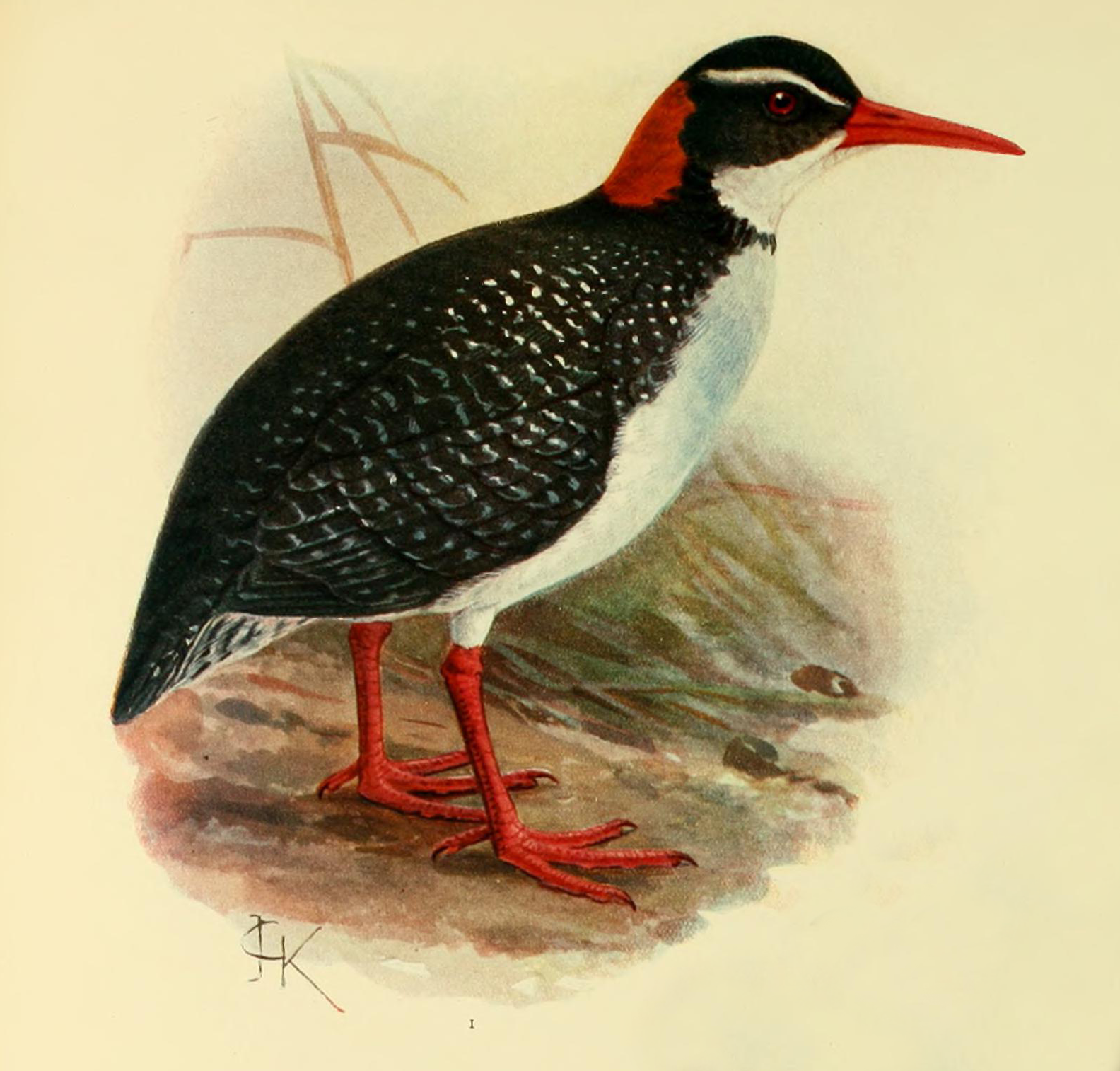
Above: part of Plate 26 in Rothschild (1907). Source: Wikimedia Commons.
References
Original scientific description:
Gmelin, Johann Friedrich (1879): [Description of Gallirallus pacificus]. In: Systema Naturae (13th edition) 1, part 2: 717.
Other references:
BirdLife International (2000) Threatened Birds of the World. Lynx Edicions and BirdLife International, Barcelona and Cambridge.
BirdLife International. (2012). Gallirallus pacificus. In: IUCN 2013. IUCN Red List of Threatened Species. Version 2013.1. (http://www.iucnredlist.org). Downloaded on 24 August 2013.
BirdLife International. 2016. Hypotaenidia pacifica. The IUCN Red List of Threatened Species 2016: e.T22692450A93354380. https://dx.doi.org/10.2305/IUCN.UK.2016-3.RLTS.T22692450A93354380.en. Downloaded on 27 June 2021.
Brooks, T. 2000. Extinct species. In: BirdLife International (ed.), Threatened Birds of the World, pp. 701-708. Lynx Edicions and BirdLife International, Barcelona and Cambridge, U.K.
Bruner, P. L. (1972). The birds of French Polynesia. Honolulu: Bernice P. Bishop Museum.
del Hoyo, J., Collar, N.J., Christie, D.A., Elliott, A. and Fishpool, L.D.C. 2014. HBW and BirdLife International Illustrated Checklist of the Birds of the World. Volume 1: Non-passerines. Lynx Edicions BirdLife International, Barcelona, Spain and Cambridge, UK.
del Hoyo et al. (2019) Handbook of The Birds of the World
Faurby, Søren, Matthews, Tom J., Triantis, Kostas A. and Sayol, Ferran. (2026). Quantifying the unrecorded loss of avian phylogenetic diversity. Ecography 2026: e08267. https://doi.org/10.1002/ecog.08267
Fuller, Errol. (1988). Extinct Birds. New York: Facts on File Publications. 256 pp.
Fuller, Errol. (2000). Extinct Birds, revised edition. Oxford: Oxford University Press.
Greenway, J. C. (1967). Extinct and Vanishing Birds of the World. Dover Publications, New York.
Hume, Julian Pender and Walters, Michael. (2012). Extinct Birds. London: T & AD Poyser. 544 pp.
Kittelberger, Kyle D., Tanner, Colby J., Buxton, Amy N., Prewett, Amira and Şekercioğlu, Çağan Hakkı. (2024). Correlates of avian extinction timing around the world since 1500 CE. Avian Research 15: 100213. https://doi.org/10.1016/j.avrs.2024.100213 [Supplementary data (List of 216 taxa)]
Knox, Alan G. and Walters, Michael P. (1994). Extinct and endangered birds in the collections of The Natural History Museum. British Ornithologists' Club Occasional Publications 1: 1-292.
Lysaght, A. (1953). A rail from Tonga. Bull. Brit. Orn. Club 73: 74-75.
Matthews, Thomas J., Triantis, Kostas A., Wayman, Joseph P., Martin, Thomas E., Hume, Julian P., Cardoso, Pedro, Faurby, Søren, Mendenhall, Chase D., Dufour, Paul, Rigal, François, Cooke, Rob, Whittaker, Robert J., Pigot, Alex L., Thébaud, Christophe, Jørgensen, Maria Wagner, Benavides, Eva, Soares, Filipa C., Ulrich, Werner, Kubota, Yasuhiro, Sadler, Jon P., Tobias, Joseph A. and Sayol, Ferran. (2024). The global loss of avian functional and phylogenetic diversity from anthropogenic extinctions. Science 386(6717): 55-60. https://doi.org/10.1126/science.adk7898 [Supplementary Materials; Dryad dataset; Zenodo codeset]
Matthews, Thomas J., Wayman, Joseph P., Cardoso, Pedro, Sayol, Ferran, Hume, Julian P., Ulrich, Werner, Tobias, Joseph A., Soares, Filipa C., Thébaud, Christophe, Martin, Thomas E. and Triantis, Kostas A. (2022). Threatened and extinct island endemic birds of the world: Distribution, threats and functional diversity. Journal of Biogeography 49(11): 1920-1940. https://doi.org/10.1111/jbi.14474 [Appendix S1 (.docx); Appendix S2 (.pdf)]
Ripley, S. D. (1977). Rails of the world. Boston, MA: David R. Goodine.
Rothschild, Lionel Walter. (1907). Extinct birds: an attempt to write in one volume a short account of those birds which have become extinct in historical times, that is within the last six or seven hundred years: to which are added a few which still exist, but are on the verge of extinction. London: Hutchinson & Co. XXIX + 243 pp. [p. 123, pl. 26]
Sayol, Ferran, Steinbauer, Manuel J., Blackburn, Tim M., Antonelli, Alexandre and Faurby, Søren. (2020). Anthropogenic extinctions conceal widespread evolution of flightlessness in birds. Science Advances 6(49): eabb6095. https://doi.org/10.1126/sciadv.abb6095 [Supplementary Material (Data File S1)]
Stattersfield, A. J.; Crosby, M. J.; Long, A. J.; Wege, D. C. (1998). Endemic bird areas of the world: priorities for bird conservation. BirdLife International, Cambridge, U.K.
Taylor, P. B. and Van Perlo, B. (1998). Rails: A Guide to the Rails, Crakes, Gallinules and Coots of the World. Robertsbridge: Pica Press.
Tyrberg, Tommy. (2009). Holocene avian extinctions, pp. 63-106. In: Turvey, Samuel T. (ed.). Holocene Extinctions. Oxford, UK & New York, USA: Oxford University Press. xii + 352 pp.
WCMC (World Conservation Monitoring Centre). (1992). Global Biodiversity: Status of the Earth's living resources. London: Chapman & Hall. xx + 594 pp.